What $2.1 million buys in Noe Valley

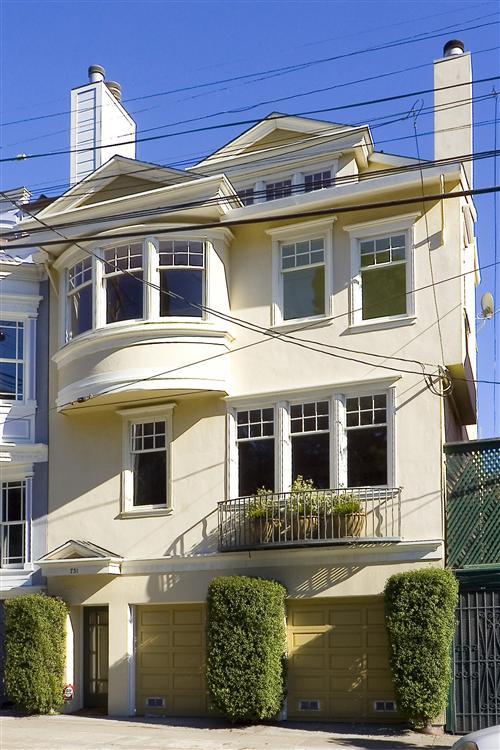
Out on brokers’ tour yesterday, I looked in on two homes  available in my Noe Valley neighborhood, priced within $2,000 of each other.  731 Douglass (at 24th Street) sold in March 2005 for $1.944 million and a mere $29o,000 in March 1997, when it was a sad-looking 1200 ft marina-style house, with a 6-car garage.  Back then:

731-douglass-old

and now:

731-douglass-now

In 1999, the owners completely redid the building, right around the same time that my wife and I were remodeling our house just around the corner and converting it from a two-unit building into a single family home.  At the time, there weren’t too many larger homes in Noe Valley.  Now, everybody seems to be adding floors or building out the basement. ...  Additional Details
Absorption R.I.P.

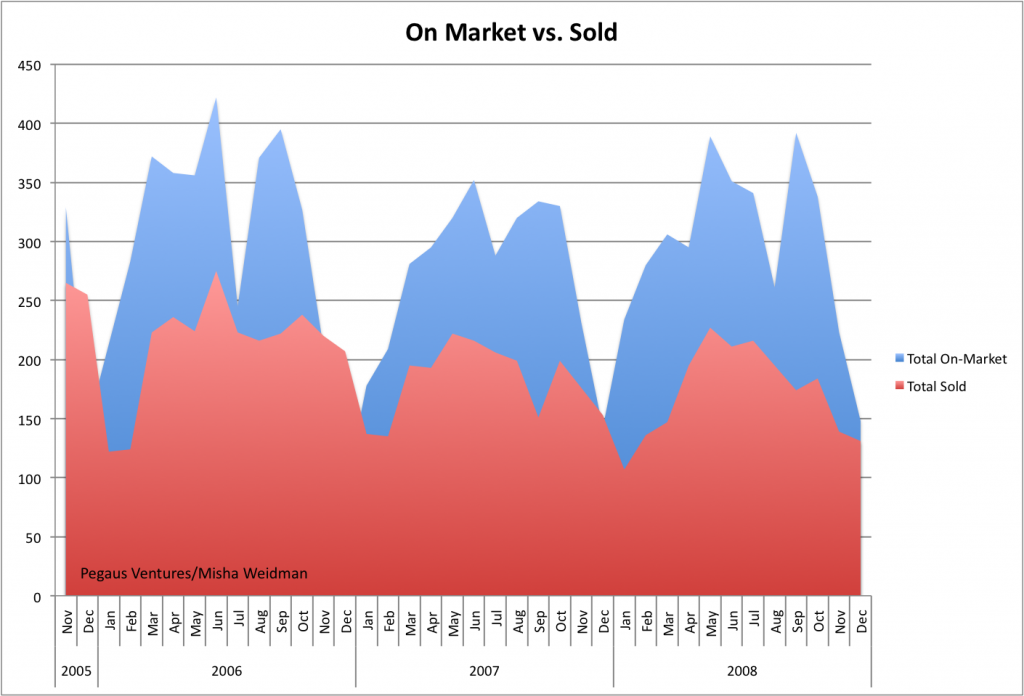
After talking to people about my last post on Absorption Rates and the lack of a correlation between slower absorption and lower median prices (or faster absorption and higher prices), I got the impression that there was some curiosity — skepticism?  — about the underlying numbers.  So I thought a post mortem of sorts was in order.  Here’s a chart that simply tracks total listings and total sales over a little more than the two years covered by the Absorption Rate chart.
on-market-vs-sold ...  Additional Details

Revised Absorption Chart, but the results are the same, only worse

Thanks, Jean-Claude for making me take a second look at my methodology on my Absorption Chart.  I had anticipated your point about the lag between listing dates and sales but had unfortunately gotten the formula backwards in my chart — basically dividing inventory by lagging sales, rather than forward sales:  moral of the story:  don’t do this stuff at 1 in the morning.)  So I redid the chart with the correct formula inserted.  (Excel groupies its =4*(AVERAGE(listings month 1, 2, 3)/AVERAGE(sales months 2, 3, and 4)). The data points at the end of the chart are averaged over shorter periods due to the lack of forward data. ...  Additional Details

Supply/Demand: Does it predict price? Maybe not.

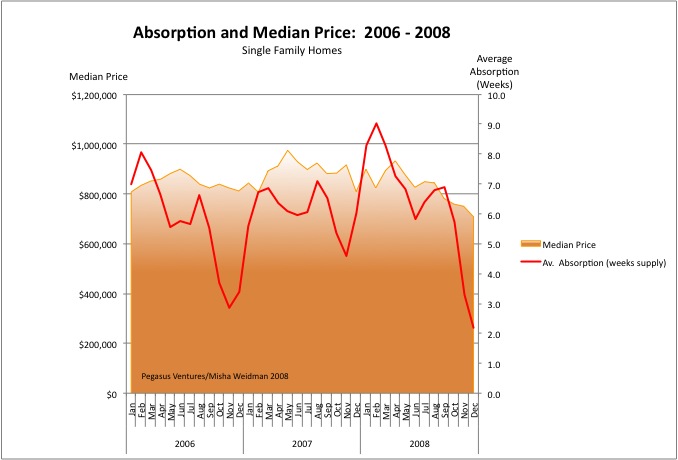
Now hold on there, matie!  Basic economic theory  says more supply than demand, prices will fall, right?  Well take a look at this graph. It shows the absorption rate of single family home listings from January 2006 through December 2008 plotted against median prices (click to make it bigger):

absorption-price-chart1

“Absorption” is basically the number of weeks it would take to sell all the homes available on the market based on the number of homes that are selling at that time.  (I’ve tweaked the formula to diminish the spikes caused by the huge seasonal dropoff in new listings each December/January.)   There are many ways to calculate absorption, but the basic idea is simply to capture how quickly demand is eating supply.  Less time to absorb the supply should reflect a “hotter” market where sellers can demand top dollar. A higher absorption rate, on the other hand, means that there’s relatively more listings on the market than demand for them.  That would tend to suggest a buyer’s market and softer prices. ...  Additional Details

Happy New Year! — The Official Blog Launch

misha-bw

Happy New Year everyone!  I’d intended to illustrate this post with suitable icons for every winter tradition from Christmas to Kwanzaa but decided against it when I  couldn’t think of a suitable graphic for non-believers.  And why should they (we) feel left out?

The image is of a sculpture by Rodin.  I saw it in the Rodin Museum in Paris during the summer of 2008 and, like so many of his sculptures, it seemed to glow from the inside.  For me, these hands express the tenderness and grace that we humans are capable of.  My wish for the New Year is that there be more of both in this  world. ...  Additional Details

The Credit Crunch from the Other Side of the Desk

I’ve written a piece as a guest-writer for The Front Steps, one of the better blogs on SF Real Estate.

After talking to loan officers and loan brokers for several weeks about the lending environment, here are the takeaways:

  • Have “perfect everything”:  high credit score, secure job, money in the bank and documentation to prove it all.
  • Figure you’ll be putting down a minimum of 20% as downpayment.
  • For the best long-term rates, to to a retail bank that you have a relationship with.
  •  ...  Additional Details

    Maybe it’s time to buy that first house….

    That’s what New York Times journalist Ron Lieber discusses in Saturday’s Business Section.  You can find a copy of the article here.  Of course, nobody really knows where the real estate market is headed but Lieber suggests that now could be a good time to buy.  Here are a few of the takeaways:

    • First-time home-buyers presumably have the down-payment sitting in the bank, so they can benefit from the drop in home values without having to worry about selling their own home in a depressed market to raise the downpayment.
    • Mortgage interest rates are currently pretty low by historical standards and could go lower if the federal government decides to try to drive them lower.  If you can lock in a low rate for 30 years, that seems pretty smart.
    • The best deals may be in “new” housing, where developers are desperate to get out from under bloated inventories.  Those inventories, however, are falling as construction of new projects has come to a halt.  With winter being a traditionally slow time to move houses, now may be a particularly good time to buy.

    Along these lines, a loan officer recently told me that he’d heard of a downtown high-rise condo that was listed for $1.1 million and was sold by the developer for $770,000 — just enough to pay off the loan amount attributable to the unit. ...  Additional Details