The San Francisco Residential Real Estate Update: An Ai Generated Glimmer of Hope?


AI generated imaged
An AI Generated Glimmer of Hope

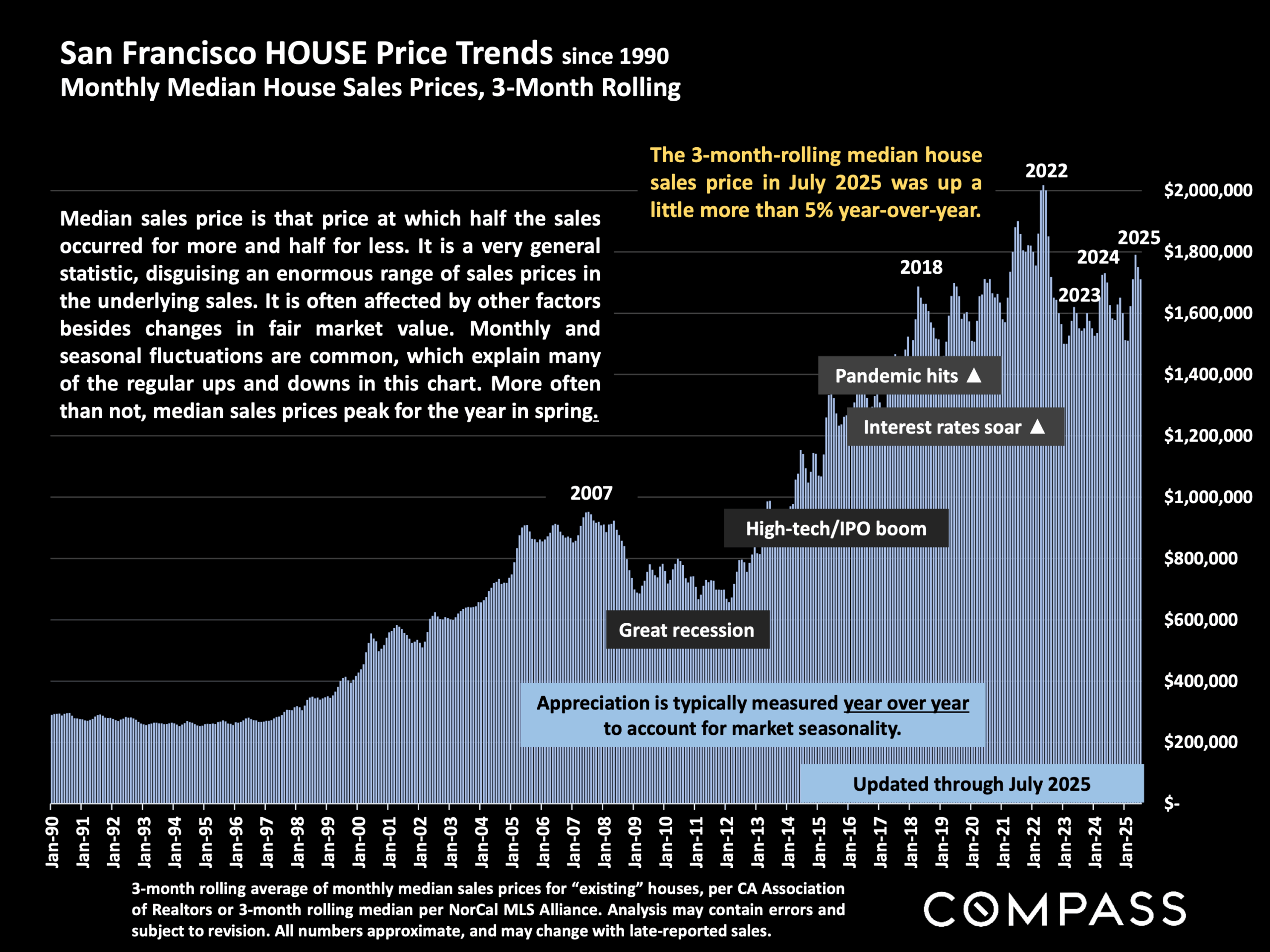
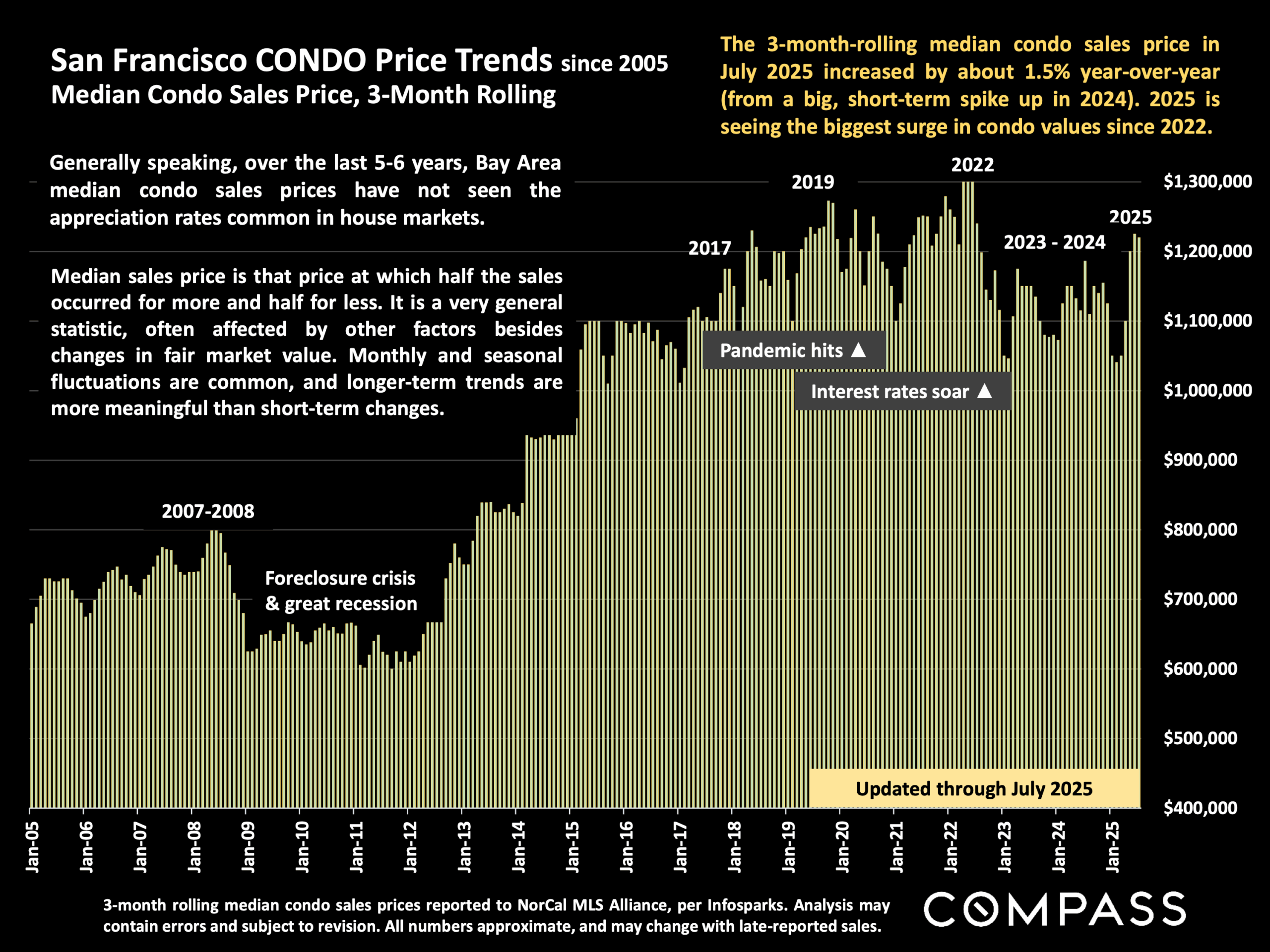
Back in May 2018, when pundits everywhere delighted in sounding the death-knell for SF’s residential market due to a host of local challenges including lack of affordability and rampant homelessness, I suggested they might be a bit premature. In the summer of 2020, months into the Covid pandemic, Zillow published data suggesting that SF was again on the skids.  Again, I suggested that “this too shall pass.”  Condo and home prices proceeded to hit record highs until 2022 when higher interest rates brought the real estate party to a stop, leaving a hangover from which much of the Bay Area — indeed the country as a whole — has yet to recover.

Interest rates are still high, albeit with indications that they may be coming down “any day now.”  Add in such challenges as the economic uncertainty engendered by Trump’s tariff wars; an enduring change in the remote/on-site work model; and a persistent narrative of SF’s “doom loop” decline, and it’s fair to ask whether SF can once again pull off a Houdini-like escape. Continue reading “The San Francisco Residential Real Estate Update: An Ai Generated Glimmer of Hope?”

San Francisco’s new “COPA” Law could turn Owners of 3+ Unit Buildings into, um, Sausage

“Coppa” with two “p’s “ is a delicious dried pork salume of Italy and Corsica.  “COPA” is a new SF law that requires owners of buildings with three or more residential units to give a right of first offer and a right of first refusal to a designated set of non-profits before they can sell their building to a third party.  If a seller fails to comply with the statutory requirements, they may well feel that they’ve been through the COPA meat-grinder.  Penalties can include disgorgement of profits and a fine equal to 10% of the sale price they received.

COPA (for “Community Opportunity to Purchase Act”) is intended to aid non-profits that are active in efforts to preserve affordable housing.  The rationale behind the Act appears to be that by providing qualified non-profits a first and second shot at buying a building subject to the Act, more buildings will come under the control of these non-profits who are then required to keep low-rent tenancies in place “in perpetuity.”  However, there’s no requirement that sellers accept below-market rate offers from the non-profits; no additional mechanism for getting more money to the non-profits so that they can compete with market-rate offers; and no proof that a market-rate sale to a private party necessarily results in evictions or rental increases anyway.  Indeed, the City has enacted numerous laws over the decades to make it increasingly hard for owners of multi-tenant buildings to increase rents (for buildings constructed before June 1979) and to permit owner move-in evictions. Buyers are already willing to pay a premium for two-unit buildings because, for the moment at least, they are not subject to San Francisco’s condo conversion moratorium whereas buildings with three or more units are.  This legislation, I suspect, will only increase the delta.  Perhaps that’s the point:  by burdening buildings of three or more units with this additional legislative hurdle to sale, they’re making them more affordable for non-profits to potentially buy. 

That kind of reasoning seems like a stretch to me.  More likely, in my view, this will result in extra fees for attorneys who have to guide sellers of these buildings through a potential minefield.  I have not researched this but I suspect the reason why non-profits are not buying up more buildings to “preserve” low-rental housing is not because they’re not aware of them being for sale but because they simply can’t compete with for-profit buyers.  This legislation does nothing to change that.

Anyone who needs more information should start with the Mayor’s Program Rules, available here.  The next step should be to consult with a qualified real estate attorney.

As always, your questions, comments and referrals are much appreciated!

Bay Area Housing Affordability: A Grab-Bag of Charts

In my July Newsletter, I did a wrap-up of the year so far and concluded that the market, for the moment at least, seems to be going sideways. Post Labor-Day inventory has already shown a big jump in anticipation of the short buy/sell season between now and the end of November. It’s too soon to say whether the new inventory will excite buyers to loosen their wallets or simply cause them to be pickier.

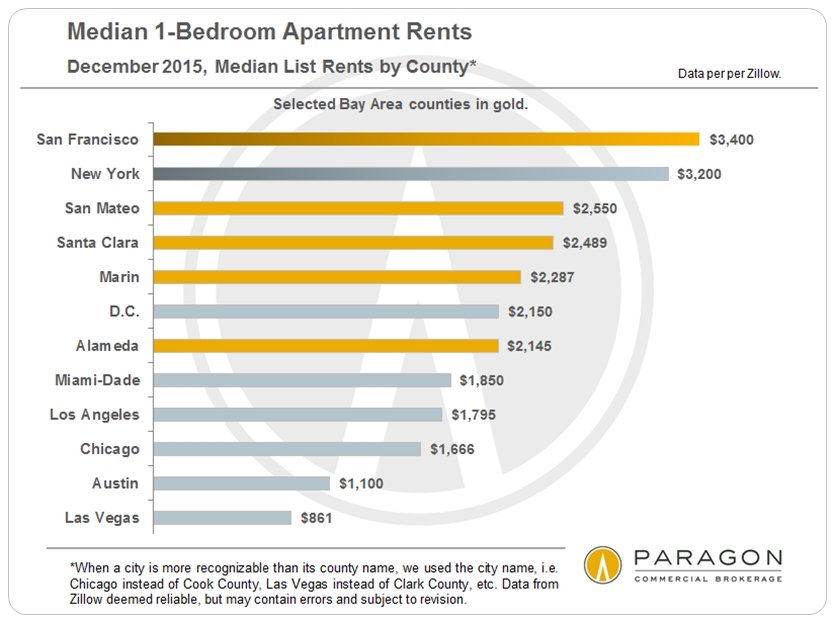
So with the market on “pause,” I thought I’d put together a grab bag of charts that cover SF housing affordability, both from the standpoint of owning and renting. Many view housing affordability as a central concern for San Francisco’s long-term future. Changes in the rental Continue reading “Bay Area Housing Affordability: A Grab-Bag of Charts”

Real Data SF July Newsletter

Mid-Year Report – A Soft Landing For San Francisco Residential Real Estate?

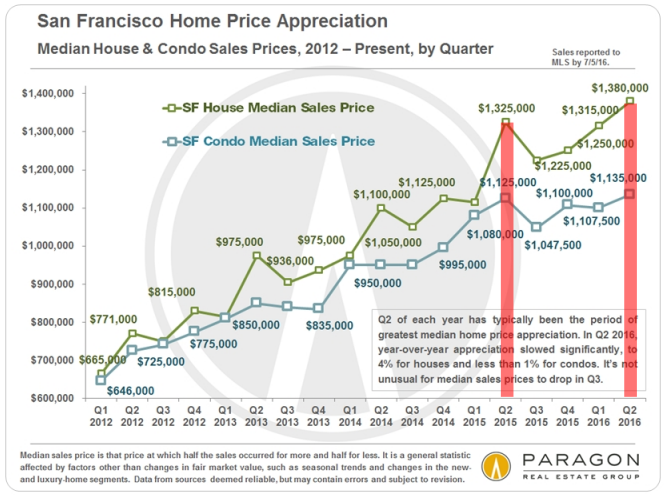
With the data in for the for the first six months of 2016, the cooling trend that I’ve noted in recent newsletters is increasingly clear. Since sales typically dip in the middle of summer due to seasonal factors (everyone, especially those who own or are looking to buy higher end homes, is on vacation), it’s best to compare 2nd quarter results with those of a year ago.

2

In Q2 2016, the year-over-year appreciation rate was 4% for houses and less than 1% for condos, as compared with 2014 to 2015 rates of 20% and 18%: A significant slowdown. However, median home prices are still at their highest point ever. Continue reading “Real Data SF July Newsletter”

Mapping the Spread of the Million Dollar Home in the Bay Area

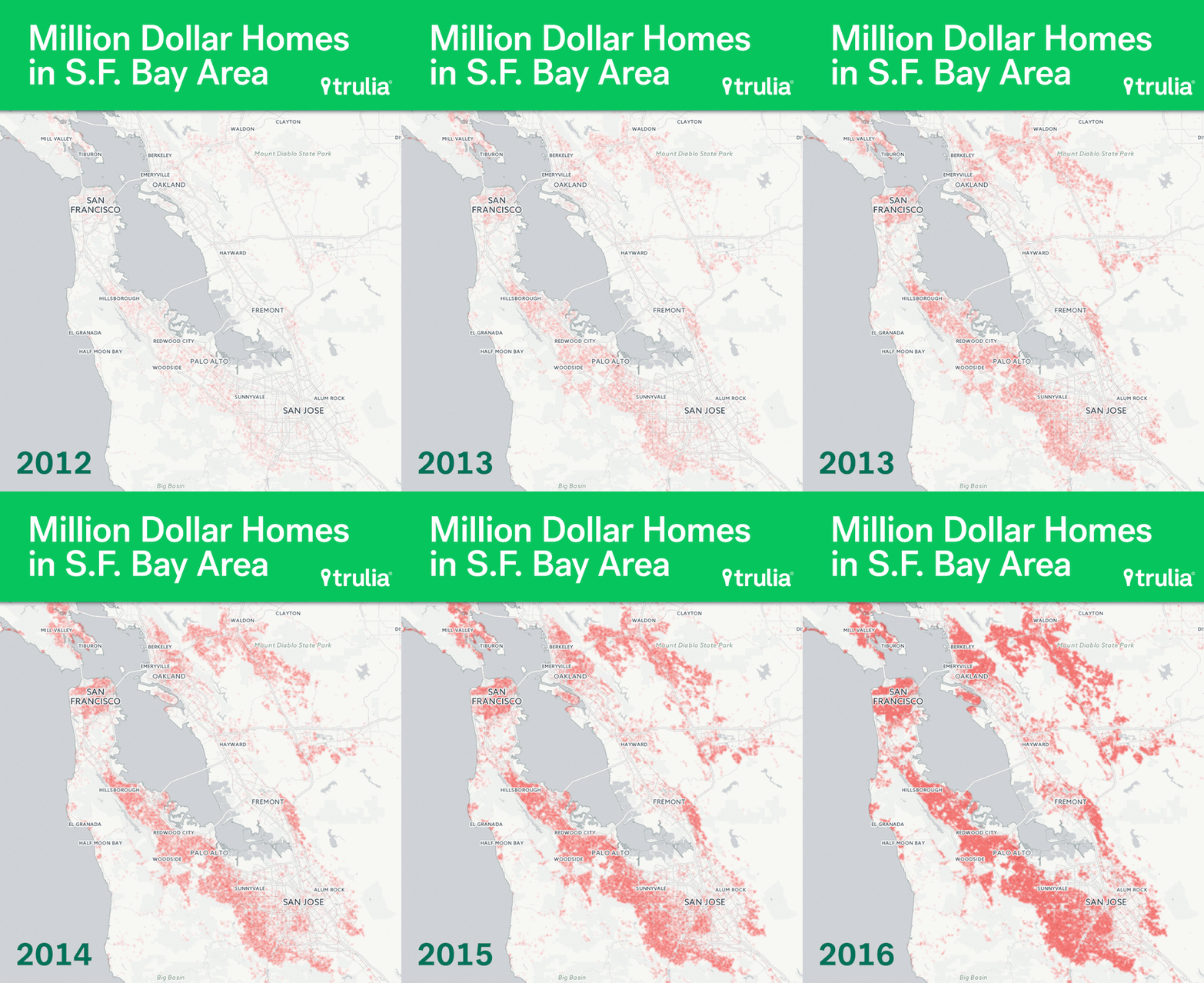
Thanks to my well-read friend at The Economist for sending me this fascinating infographic.

You can find the full article here at The Atlantic. Their choice of Westwood Park as their poster-neighborhood is an interesting one. On the one hand, it’s a tiny area tucked in to the west of City College between Monterey and Ocean Avenue and it’s not exactly a household name, even to longtime SF denizens. On the other hand, the statistics are impressive: four years ago, according to the article, just 2.9% of its homes cost $1 million or more. Today, 96% of them do.
Only in San Francisco would a $1 million home be considered “a bargain.” But I think that it’s precisely in the lesser-known neighborhoods loosely clustered around Mount Davidson like Westwood Park, Miraloma Park, and Monterey Heights, where a buyer can still find “value.”

“Bubble” or “Breather”: Whither San Francisco’s Home Market?

image001Just a few days ago, The San Francisco Business Times reported that a third of the national housing experts surveyed by Zillow described the Bay Area’s housing market as being currently in a bubble. Here’s the table that shows how the experts came out on the “bubble” question, courtesy of Pulsenomics, who conducted the survey for Zillow.

Continue reading ““Bubble” or “Breather”: Whither San Francisco’s Home Market?”