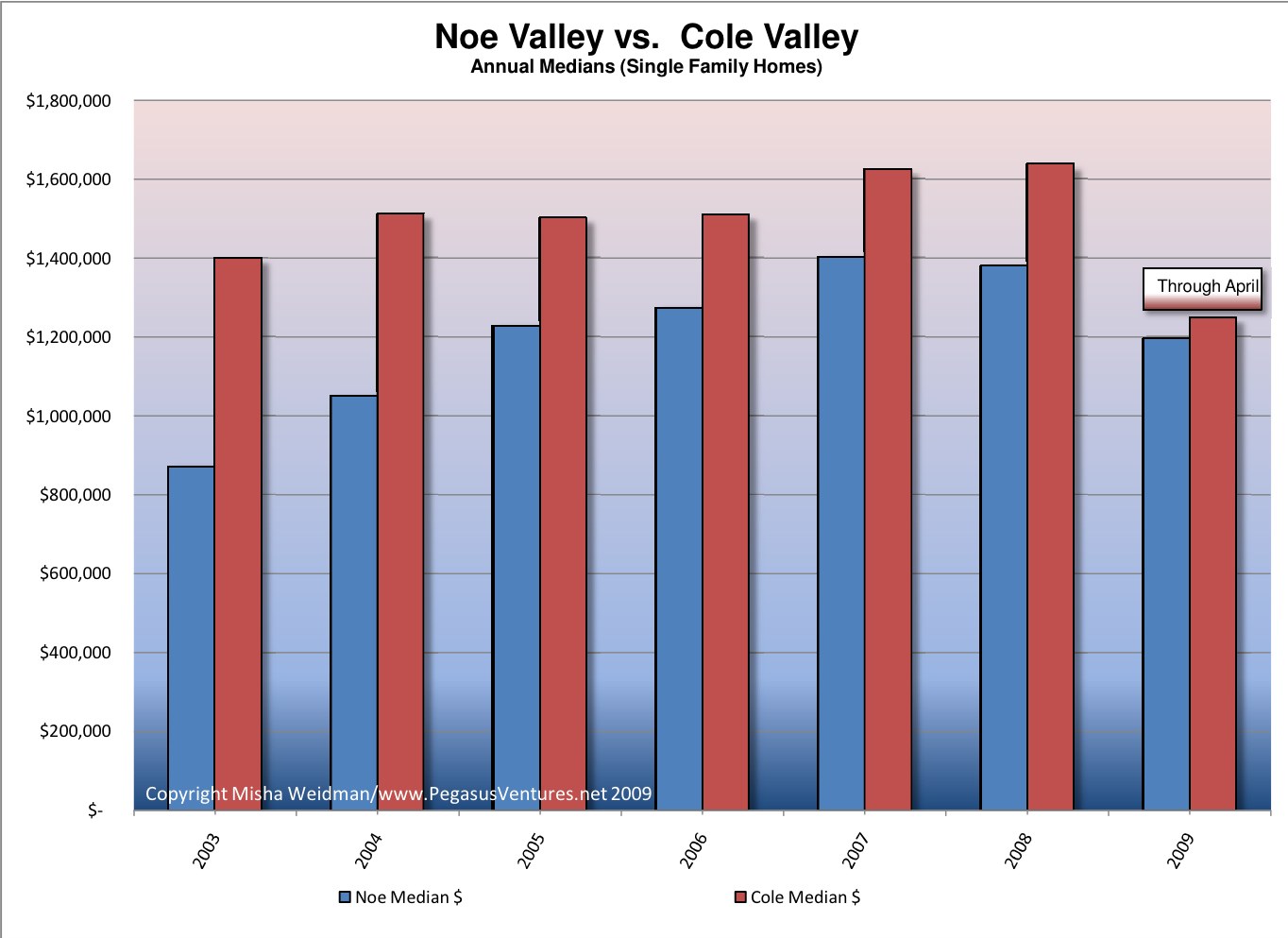
It seems only fitting that since my last few posts have focused on Cole Valley and Noe Valley, we should take a look at them head to head. Since Cole Valley has relatively few monthly sales, I’ve compared median values on an annual basis. Here are the results (click):
Say what you want about the two valleys, you’re going to pay more if you live in Cole. About $200,000 more, to be precise. Before you conclude that the premium all but vanished in 2009, remember that there have only been five Cole Valley home sales so far this year. Way too few to conclude anything other than that nothing’s selling or that homeowners are so addicted to the breads and pastries at La Boulange that they can’t leave. ...Additional Details
Noe Valley has its 24th Street shops and cutesy cafés. Cole Valley has, well, its Cole Street shops and cutesy cafés. The two neighborhoods have been engaged in a friendly battle for the hearts of San Francisco homeowners for as long as I can remember.
After doing a guest post on Noe Valley price trends at theFrontSteps a few weeks ago, Alex, tFS’s friendly editor, suggested that I do a side-by-side comparison of sales trends in Cole Valley and Noe Valley.
Great idea, I thought! Trouble is, Cole Valley sits within a tiny subdistrict of the MLS (see the pink area below?) and as a result, there very few transactions from month to month. ...Additional Details
I’ve been having an interesting discussion with a regular reader of theFrontsteps, where I first posted my chart on Noe Valley Percentage Change from All-Time High. He disputes the fact that Noe Valley has fallen by 30% from its all-time high (reached in March of 2008) because he claims — I think — that March was aberrational. I’ve looked again at the data for that month and I disagree. What’s more I think that if you look simply at median prices (moving averages), they show a pretty extended upward trend from the beginning of 2006 through March 2008, with the exception of a dip during the Fall of 2007. Here’s the chart (click to enlarge). Enough said. I’m moving on to another subdistrict. ...Additional Details
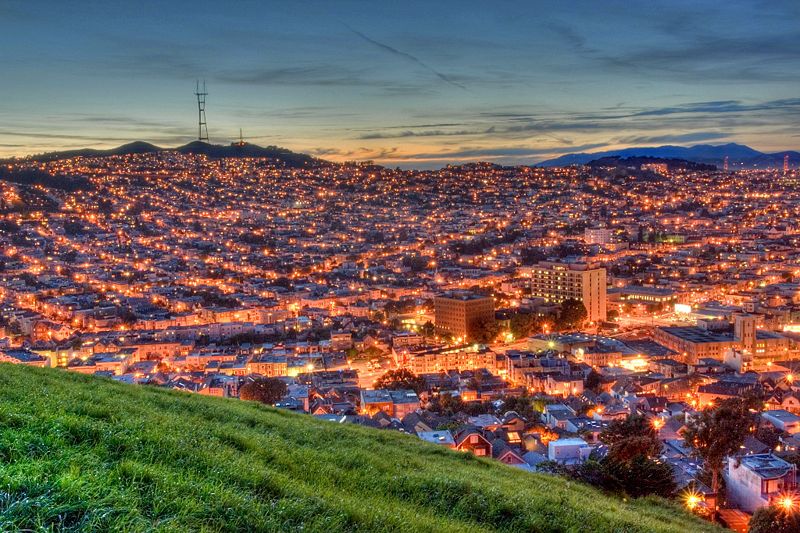
Photo: Jack French -- Used under Creative Commons Permission 2.0
Noe Valley’s been my home since 1991 so I’ll admit that I track it with more attention than other neighborhoods. For quite a few years now it’s also had a reputation for maintaining home values even as the rest of the city stumbles. The question is whether that’s still true.
Back when I bought my two-unit home at a probate sale with one other bidder in attendance, the “hood” was closer to its working class roots. Lots of single-story cottages in the 1200 square foot range and lots of duplexes. It had a thriving lesbian community and was popular with singles who couldn’t afford to rent in the Marina. It was San Francisco’s stealth neighborhood, just out of yuppy radar range.
By the mid-90’s it was growing increasingly popular with young families who were drawn to its slightly sleepy streets, decent weather, cute parks. The shops along 24th Street had everything you could possibly need, but without the attitude of Fillmore Street or the grunge of the Haight. All this, and decent Muni service downtown to boot.
When the dot-commers discovered that it also had great access to 280 and points south, prices took off. Two-unit buildings started converting to single family homes (that’s what we did). Little cottages would suddenly grow an extra floor, or a built-out basement, or both. Suddenly, we started seeing 2,500 foot homes and even the occasional trip-K (3,000 sf).
Prices inflated along with the floor-plans. The million dollar mark was crossed some time around 2000. The dot-com bust barely caused a blip. By 2005 we were seeing feeding frenzies over houses approaching $1,000 per foot. Even after the market started cooling off in 2007, Noe Valley prices seemed to defy gravity.
There’s nothing more local than real estate. Could it be that Noe Valley was situated in some sort of socio-economic sweet-spot? Many thought so, including me. And until recently it was true. But no longer. Take a look (click to enlarge): ...Additional Details
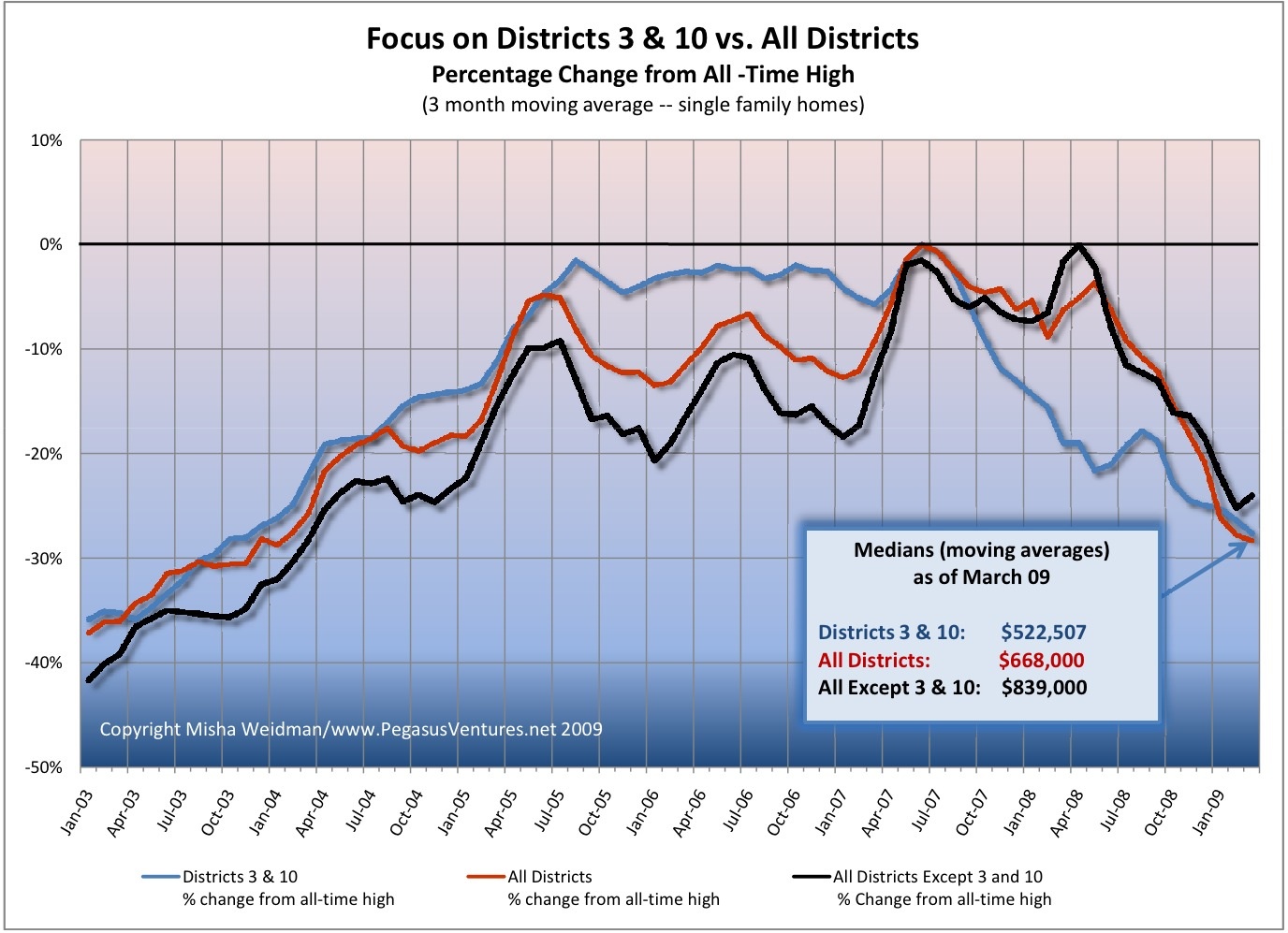
The Excelsior, Bayview, Hunter’s Point, Oceanview, Ingleside: these are some of the neighborhoods included in the San Francisco Association of Realtors’ MLS (Multiple Listing Service) Districts 3 and 10. It’s been suggested here and elsewhere that perhaps these non-“core” San Francisco neighborhoods have been pulling down San Francisco’s home prices disproportionately. The theory, plausible enough, is that these more modestly-priced neighborhoods would be feeling the effects of the economic slowdown more than the tonier “core” neighborhoods, whose denizens’ bank accounts might provide a little more padding against hard times.
I recently published a chart that compared the percentage change of Districts 3 and 10 from their all-time highs to that of the city as a whole. Some readers of theFrontSteps expressed an interest in seeing what the chart would look like if you excluded those districts from the data set for the city as a whole. (Districts 3 and 10 make up over 20% of the city’s single family home sales for the 5 year period covered by the chart.) I aim to please, so I ran the numbers again and here are the results. ...Additional Details
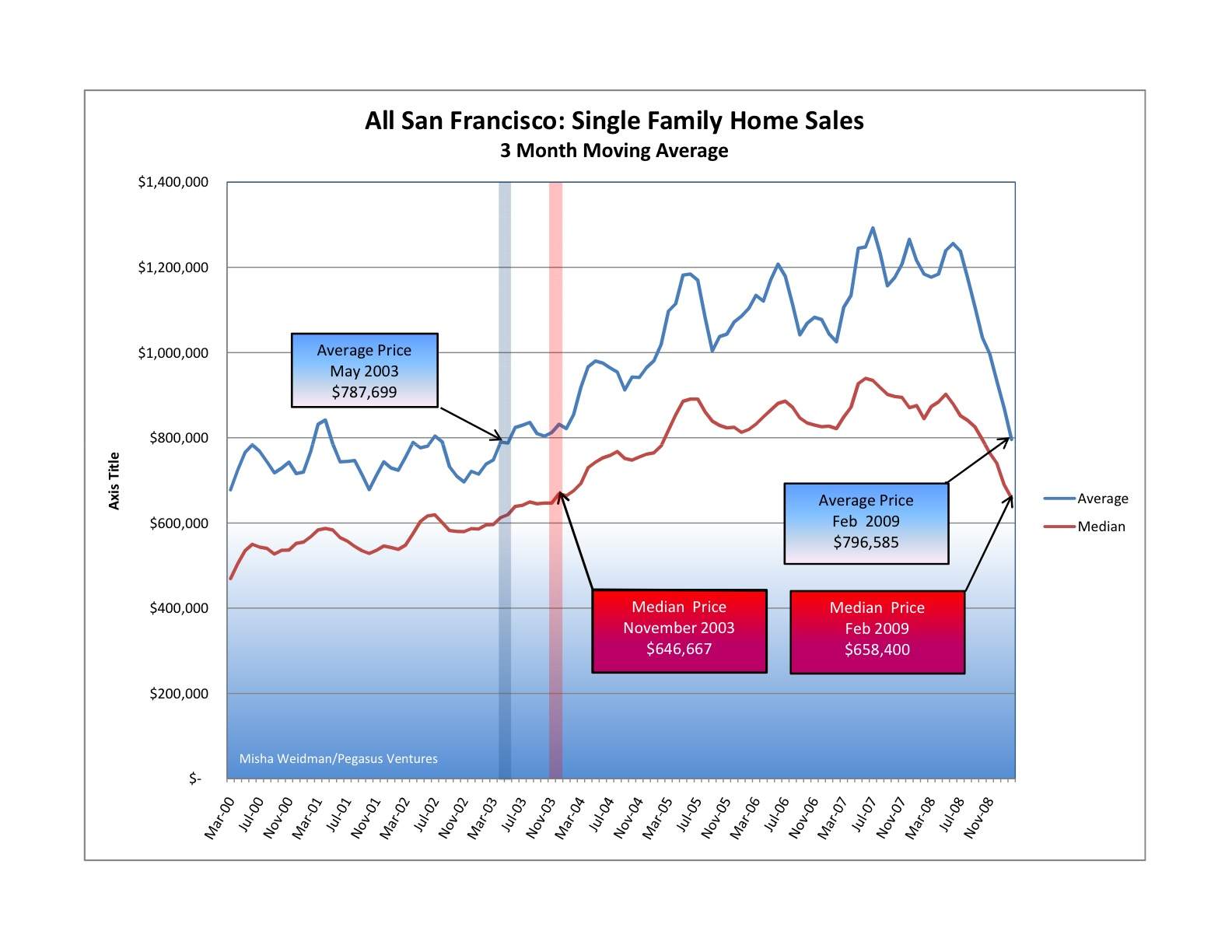
Not long ago I did a guest post at The Front Steps in which I showed that city-wide home prices had fallen back to November 2003 levels. Here’s the chart.
That prompted some discussion about whether the results would be different if you excluded home sales in some of San Francisco’s outlying areas, such as the Bayview and the Westlake districts. These and other neighborhoods are included in MLS (Multiple Listing Service) Districts 3 and 10. Here’s the official MLS district map. ...Additional Details
…or so proclaims my venerable data-crunching guy at the REreport. All the data is available and updated monthly under my “Market Trends” tab, organized by MLS District, or city-wide, annual or monthly, single family or condo — it’s all available here.
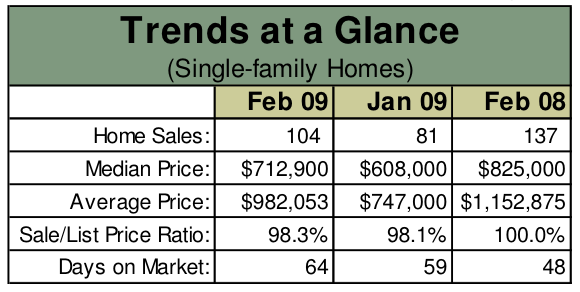
This chart, from the lead-in page, shows unit sales and median prices for both homes and condos are up from Jan 09, but down year over year.
But not so fast. Much as I’d love to believe we’ve hit bottom, it’s hard to know whether this is anything more than the usual seasonal uptick in sales now that we’re coming out of the winter doldrums. Here’s the chart for single family homes sales. See those incredibly regular troughs right around Jan/Feb each year? I’d say it’s way to early to declare a bottom. ...Additional Details
Sorry, folks, but it’s that bad — or good, depending on your perspective.
I tracked average and median prices going back to 2000 for the ten combined MLS districts that comprise the San Francisco Multiple Listing Service — the big database that realtors use to list properties and record sales information . (The MLS District Map is here, on my Market Trends page.) Here are the results (click to make the chart bigger):
Pretty scary stuff, especially when you look at the suislide (a new word is born?) that started in June of last year and shows no signs of slowing down. ...Additional Details