January Data Sings the Blues

Here’s the latest sales data broken down by MLS District.  Full reports are available here under the Market Trends Tab and are well worth a look.
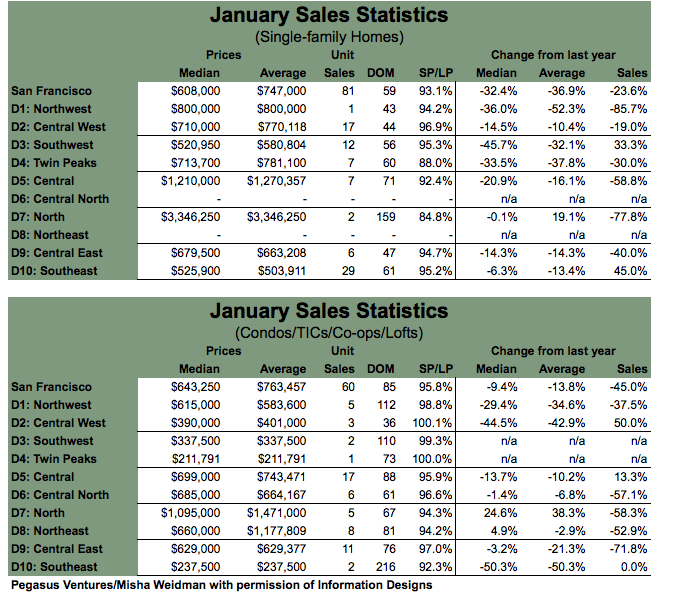
picture-2

Median and Average prices are down substantially year over year for single family homes in all districts except District 7 (“North”, which includes top-shelf enclaves like Pacific Heights and the Marina), but with only 2 sales for the month in that area, it’s not a meaningful statistic.  Indeed, as I’ve pointed out in previous blogs, sales drop off so dramatically every year during December/January that I’d be cautious reading too much into the  statistics for those particular months.  ...  Additional Details
DOM Roll Please

A couple of posts ago, we dispensed with Absorption Rate as a good barometer of the market since there appeared to be no correlation between how much inventory was available in relation to sales rates and where median prices were going.  I asked whether there might be a different metric that would correlate better, like the oft-quoted Days on Market or “DOM.”

In essence, DOM tracks the average number of days that properties have been on the market from the time they became active on the MLS (Multiple Listing Service used by realtors) to the time they actually sell. ...  Additional Details

…And what $850,000 buys in Noe Valley

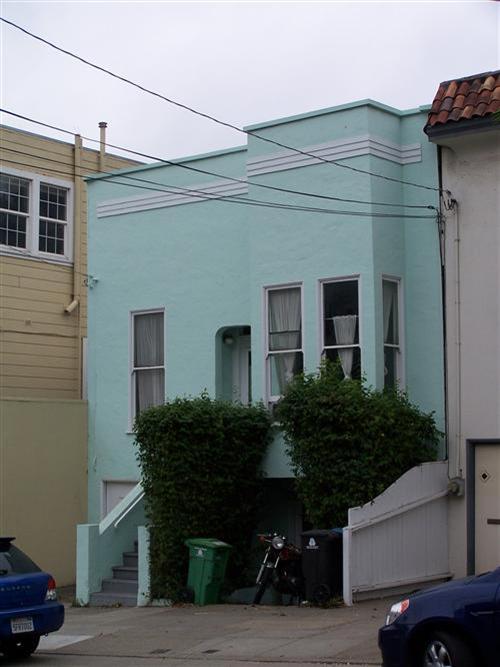
4317 24th Street @ Douglass originally listed back in October for a cool $995,000.  It’s advertised as a  4 BR/2.5 BA.  (Ahem.  This is a fixer folks.)

4317-24th-street
4317-24th-street

Interesting to note that 4209 24th Street, just a block away and very much a fixer along the same lines,  sold in December 08 for $896,000.  That was $11,000 above the asking price.

4209-24th-street
4209-24th-street

What $2.1 million buys in Noe Valley

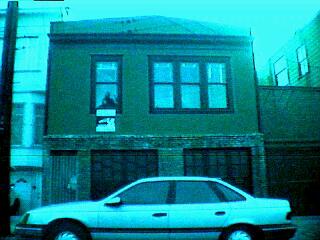
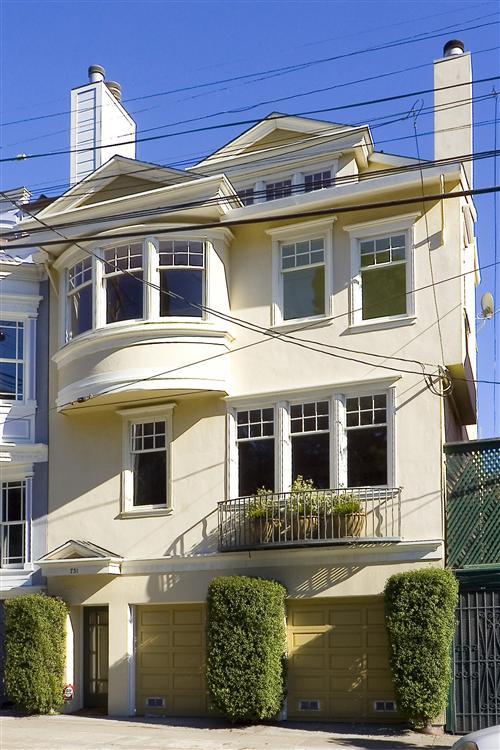
Out on brokers’ tour yesterday, I looked in on two homes  available in my Noe Valley neighborhood, priced within $2,000 of each other.  731 Douglass (at 24th Street) sold in March 2005 for $1.944 million and a mere $29o,000 in March 1997, when it was a sad-looking 1200 ft marina-style house, with a 6-car garage.  Back then:

731-douglass-old

and now:

731-douglass-now

In 1999, the owners completely redid the building, right around the same time that my wife and I were remodeling our house just around the corner and converting it from a two-unit building into a single family home.  At the time, there weren’t too many larger homes in Noe Valley.  Now, everybody seems to be adding floors or building out the basement. ...  Additional Details

Absorption R.I.P.

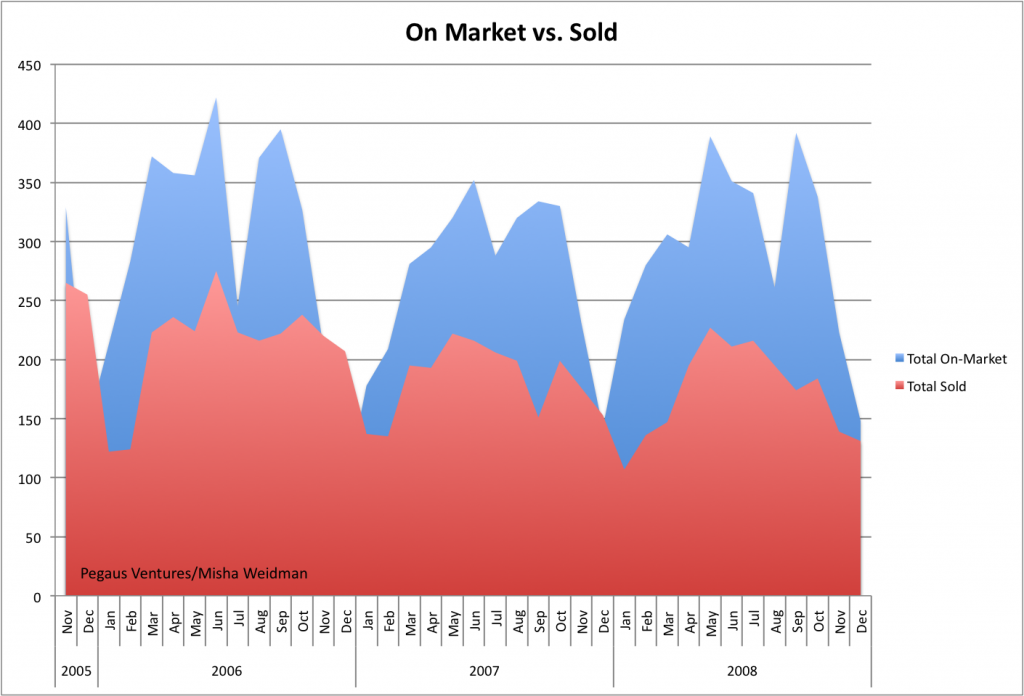
After talking to people about my last post on Absorption Rates and the lack of a correlation between slower absorption and lower median prices (or faster absorption and higher prices), I got the impression that there was some curiosity — skepticism?  — about the underlying numbers.  So I thought a post mortem of sorts was in order.  Here’s a chart that simply tracks total listings and total sales over a little more than the two years covered by the Absorption Rate chart.
on-market-vs-sold ...  Additional Details

The Credit Crunch from the Other Side of the Desk

I’ve written a piece as a guest-writer for The Front Steps, one of the better blogs on SF Real Estate.

After talking to loan officers and loan brokers for several weeks about the lending environment, here are the takeaways:

  • Have “perfect everything”:  high credit score, secure job, money in the bank and documentation to prove it all.
  • Figure you’ll be putting down a minimum of 20% as downpayment.
  • For the best long-term rates, to to a retail bank that you have a relationship with.
  •  ...  Additional Details

    Maybe it’s time to buy that first house….

    That’s what New York Times journalist Ron Lieber discusses in Saturday’s Business Section.  You can find a copy of the article here.  Of course, nobody really knows where the real estate market is headed but Lieber suggests that now could be a good time to buy.  Here are a few of the takeaways:

    • First-time home-buyers presumably have the down-payment sitting in the bank, so they can benefit from the drop in home values without having to worry about selling their own home in a depressed market to raise the downpayment.
    • Mortgage interest rates are currently pretty low by historical standards and could go lower if the federal government decides to try to drive them lower.  If you can lock in a low rate for 30 years, that seems pretty smart.
    • The best deals may be in “new” housing, where developers are desperate to get out from under bloated inventories.  Those inventories, however, are falling as construction of new projects has come to a halt.  With winter being a traditionally slow time to move houses, now may be a particularly good time to buy.

    Along these lines, a loan officer recently told me that he’d heard of a downtown high-rise condo that was listed for $1.1 million and was sold by the developer for $770,000 — just enough to pay off the loan amount attributable to the unit. ...  Additional Details

    Dataquick vs MLS: why the discrepancies?

    In my October 27 blog discussing the Case-Shiller Index, I referred to Bay Area County stats from Dataquick that showed San Francisco’s median prices to be down 12.7% from a year previous (YOY) vs.  the 11.36% that I’d quoted in my October 23 blog.

    The reason for the discrepancy?  Dataquick compiles its figures from the San Francisco County Recorder’s Office; my numbers come from the MLS.  Transactions like foreclosures or transfers between family members or between legal entities generally don’t involve agents or brokers so they don’t show up in the MLS.  They also tend to be at lower values because they are often at below market rates, so Dataquick’s numbers will always be somewhat lower than the numbers pulled from the MLS.  Thanks to Rick Campbell at the REReport for his quick response. ...  Additional Details