The San Francisco Residential Real Estate Update: An Ai Generated Glimmer of Hope?


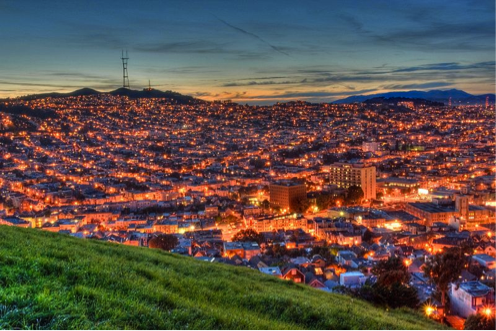
AI generated imaged
An AI Generated Glimmer of Hope

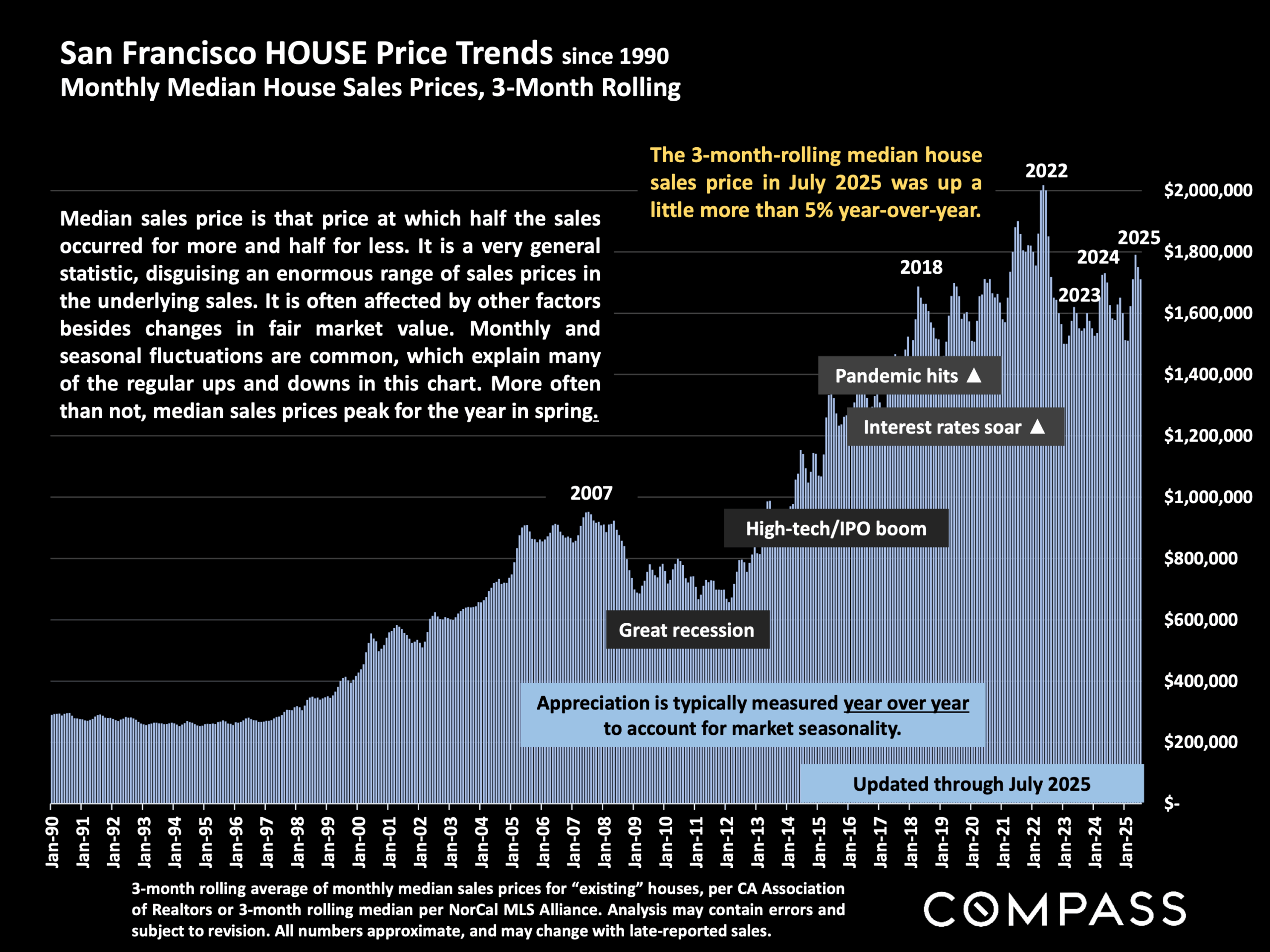
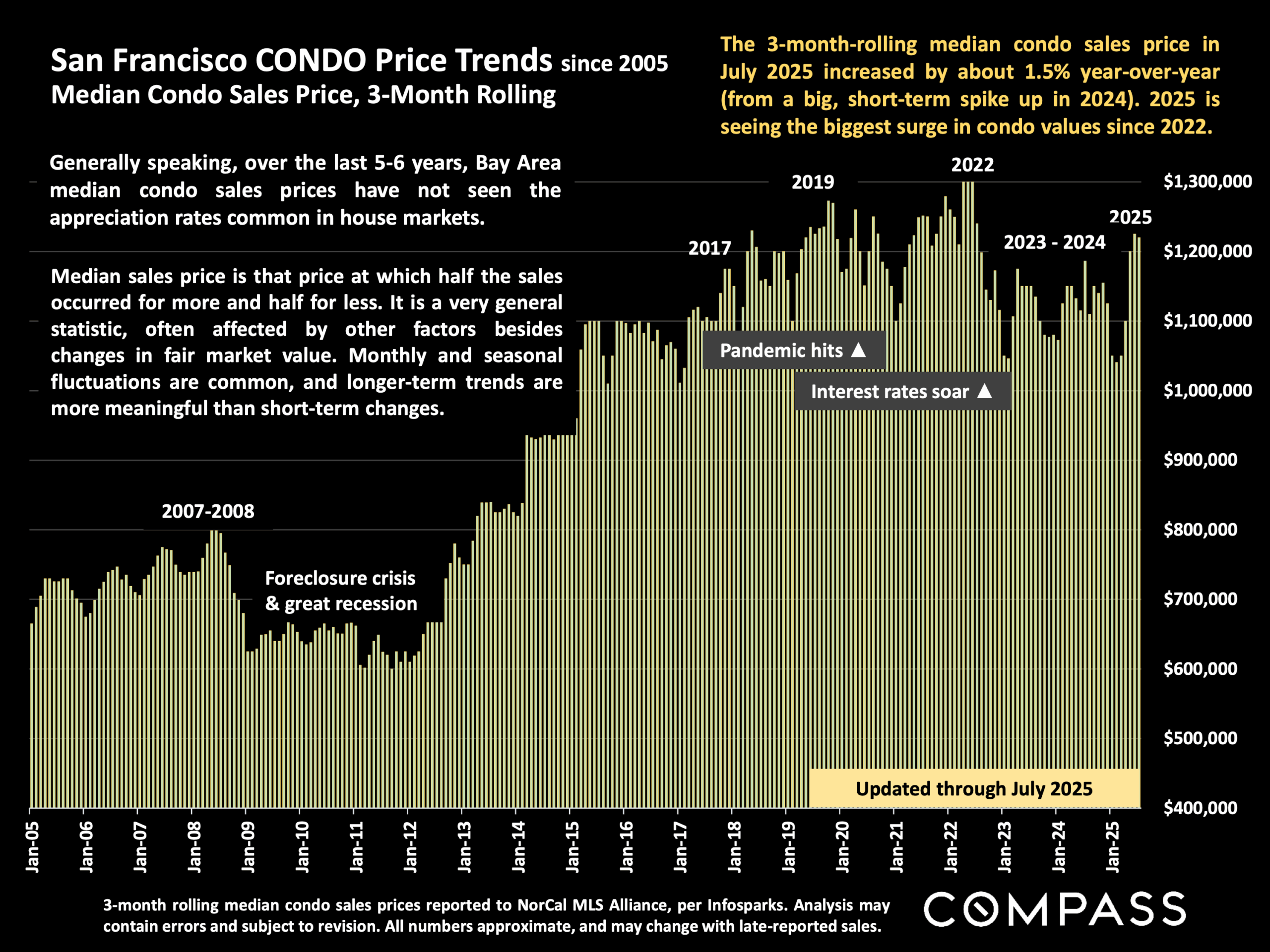
Back in May 2018, when pundits everywhere delighted in sounding the death-knell for SF’s residential market due to a host of local challenges including lack of affordability and rampant homelessness, I suggested they might be a bit premature. In the summer of 2020, months into the Covid pandemic, Zillow published data suggesting that SF was again on the skids.  Again, I suggested that “this too shall pass.”  Condo and home prices proceeded to hit record highs until 2022 when higher interest rates brought the real estate party to a stop, leaving a hangover from which much of the Bay Area — indeed the country as a whole — has yet to recover.

Interest rates are still high, albeit with indications that they may be coming down “any day now.”  Add in such challenges as the economic uncertainty engendered by Trump’s tariff wars; an enduring change in the remote/on-site work model; and a persistent narrative of SF’s “doom loop” decline, and it’s fair to ask whether SF can once again pull off a Houdini-like escape. Continue reading “The San Francisco Residential Real Estate Update: An Ai Generated Glimmer of Hope?”

A changing market? Have SF home prices reached a plateau?

The market usually does slow down at least a little in mid-summer – a question has come up: is this possible slowdown caused by listing agents continually pushing the envelope on pricing for new listings or pricing to the last, highest, frenzied sale, a move that buyers are now finally starting to resist? It may be, that without buyer demand really slackening for homes deemed “reasonably” priced, we have come to a point, at least for the time being, that buyers are no longer willing to pay new tippet-top peak prices.

1

Have prices reached a plateau? Monthly median price stats are subject to fluctuation without great meaningfulness (which is why I prefer quarterly or longer periods), but after the big jump early in the year, the median sales price has been within a 4-5% spread (not a huge spread for monthly home prices) for 5 months, Including a drop from April-May. The idea of a plateau contradicts the recent Case-Shiller Index report, but the Index is about 3-5 months behind current realities, San Francisco is only a tiny part of the Index and the city has outperformed C-S since the turnaround began – having appreciated so much faster than other places, we may be due a flattening of appreciation before other areas. And that also may be true for different SF neighborhoods – since they have rebounded at different speeds, some may be plateauing and others are still appreciating.

At this point, this is speculation and it won’t be clear for a while – these things only become clear in retrospect – because spring median prices sometimes spike and summer prices drop a little as some of the higher end market checks out for the holidays. And median sales prices are not perfect correlations of changes in market value, being affected by a number of other factors, including seasonality. Anecdotally, we are hearing stories of the market not responding to homes priced at the top (even if “justified” by another recent sale), and also stories in which the winning bidder offered a huge amount, sometimes hundreds of thousands of dollars, more than what the second highest buyer was willing to pay – i.e. the winning buyer ultimately paid much more than necessary to win the deal.

The number of expired/withdrawn listings is also increasing, though not to some crazy level yet.

So it’s worth considering, that we “may” have reached a plateau or bumped into a ceiling, transitioning into a somewhat different market. If we are in a transition, the market will be schizophrenic for a while: some buyers acting one way and another growing group of buyers acting another.

Summarizing the charts above and below:

  • The San Francisco Median Home Sales Price has leveled off, dropping somewhat from an April-May peak. (Chart above)
  • Buyer demand is still extremely high as measured by Percentage of Listings Accepting Offers.
  • Inventory is still extremely low as measured by Months Supply of Inventory and Units for Sale.
  • The number of Expired & Withdrawn listings climbed in July and was about 19% higher than July of 2012 (though less than half the number of July 2011). The main reason why listings expire or are withdrawn from the market is that buyers have concluded they are priced too high.
  • The July snapshot makes it clear that the market is still very strong by any reasonable measure, even if it might be on the cusp of a transition to a somewhat less fevered state.
  • Demand, as measured by percentage of listings accepting offers, is still very high:

    2

    Months Supply of Inventory is still very low:

    3

    The number of homes for sale is still very low:

    4

    The number of expired and withdrawn listings has been increasing:

    5

    Looking at July’s sales, mostly ratified in June, the market is still very hot:

    6

Case-Shiller: Different Bubbles, Different Accelerating Recoveries

Note: Case-Shiller Home Price Indices for “San Francisco” are for a 5-county area, of which the city’s housing market is a very small part. Since they are published 2 months after the month of the Index, are 3-month rolling averages, and the time between offer acceptance and closed sale typically runs 4-8 weeks, Case-Shiller is generally 3-6 months behind the market itself, i.e. when offers are being negotiated in the present. Case-Shiller publishes 4 main indices for SF Metro Area houses: an aggregate index for all price ranges, and then one index for each third of unit sales – low price, middle price and high price tiers.

When the market fell from its peak in 2006-early 2008 (different areas and different market segments peaked at different times), the scale of the decline varied widely, mostly by price point. With the recovery that began in 2012 and accelerated in 2013, the magnitude of the price recovery, as compared to previous peak values, has also varied by price point and area.

The lowest price range (terribly affected by foreclosures and distressed sales) fell most dramatically – approximate 60% decline – and though recovering dramatically on a percentage basis, is still way below its peak. It simply has much more loss to make up.

1

The upper price range (the top third of unit sales) in the 5-county metro area fell much less during the bubble pop and with the recovery is getting close again to peak values:

2

This chart below illustrates the short-term changes in the C-S high tier index: the recovery in 2012 accelerating in 2013:

3

And then looking just atthe city of San Francisco itself, which has, generally speaking, among the highest home prices in the 5-county metro area: many of its neighborhoods are now blowing past previous peak values. Note that this chart has more recent price appreciation data than available in the Case-Shiller Indices and that the rate of appreciation accelerated in the March-May timeframe. This is also for both houses and condos combined, when the C-S charts used above are for house sales only.

4

The Economist on Bubbles — Neat Interactive Chart Feature

The Economist has a good article (about the US real estate market not being in a bubble) and created a terrific interactive graph that allows you, by metro area (you have to click on San Francisco to add it to the graph), to compare home price changes in real terms over time, versus average incomes, and versus rents, from 1987 to 2013. San Francisco is at the top of the chart in percentage increase and increases in prices in real terms, but still rates right at the long-term average in home prices versus income and versus rents. The Economist was one of the very first to identify the housing bubble inflating – running strongly against the then current opinion of other pundits – so I think their opinion on whether another bubble is about to burst in the U.S. is worth hearing. (FYI: The do believe there are serious housing bubbles in certain other countries.)

”The verdict: in most markets houses are near or above their long-run values, but none looks bubbly. Price rises in Phoenix, Tampa and Miami have restored values only to their long-run averages. In Las Vegas they are still below that long-run average. Many things could trip up the housing recovery, from stalling job growth to higher mortgage rates; at the moment, a bursting bubble is not one of them.”

You can play around with the interactive chart, and you should read the article below the chart widget:

Here are 3 of their charts with San Francisco added:

Home Price Appreciation in Real Terms (Adjusting for Inflation):

1

Home Prices Against Average Income:

2

Home Prices versus Rents:

3

How Hot is My Valley

Real Data SF: May 2013 Newsletter

How Hot is My Valley

Noe Valley that is. The place I’ve called home since May 1991 when I bought a vacant two unit building with a monumentally dreary exterior, deeply embedded cat-pee stains in the hardwood floors, and rooms with great volume and light.

This month’s newsletter is dedicated to the Noe Valley market, and the nearby areas of Eureka Valley (aka the Castro) and Cole Valley, which have a similar feel and housing stock. Continue reading “How Hot is My Valley”

San Francisco & Bay Area Home Values – in Maps

May 2013 Update

Below are 3 maps delineating recent median home sales prices and/or average dollar per square foot values for San Francisco neighborhoods and communities around the Bay Area. These statistics are generalities which may fluctuate for a variety of reasons, but still give an idea of comparative home values in and around the city.

Generally speaking, home price appreciation is continuing and indeed accelerating in 2013, extending the upward swing that began in 2012. This is being supercharged by increasing demand meeting inadequate supply. For more information about current market conditions and trends, please click on the “Market Dynamics Charts” link above.

In the maps below, “k” signifies thousands of dollars; “m” signifies millions; “$/sf” means average dollar per square foot; and “N/A” means there wasn’t enough data to generate a reliable number.

Home Values around the San Francisco

1

San Francisco Neighborhood HOUSE Values

2

San Francisco Neighborhood CONDO Values

3

Real estate statistics in the Bay Area are based upon that relatively unique basket of homes that happen to sell within any given period, so instead of being exact measurements applicable to specific properties, they should be considered indications of the direction and approximate scale of market trends.

Median price is that price at which half the sales occurred above and half below – a single additional sale can sometimes make a 3-5% difference in overall median price, especially when the number of sales is low. Dollar per square foot is based on “livable space”, which should not include decks, patios, yards, garages, unfinished basements and attics, or rooms built without permit (“bonus rooms” and “in-law apartments”). Square footage figures are often unreported, measured in different ways or simply unreliable. Both these statistics can be affected by other factors besides changes in value, such as seasonality, available inventory, variations in buyer profile, changes in the distressed and luxury home markets, and variations in average home size (all things being equal, a smaller home will have a lower sales price but a higher dollar per square foot value than a larger home).
These analyses were performed in good faith with data derived from sources deemed reliable, but they may contain errors and are subject to revision. If you have any questions, please contact us.