SF Real Estate Heats Up as the Weather Cools Down

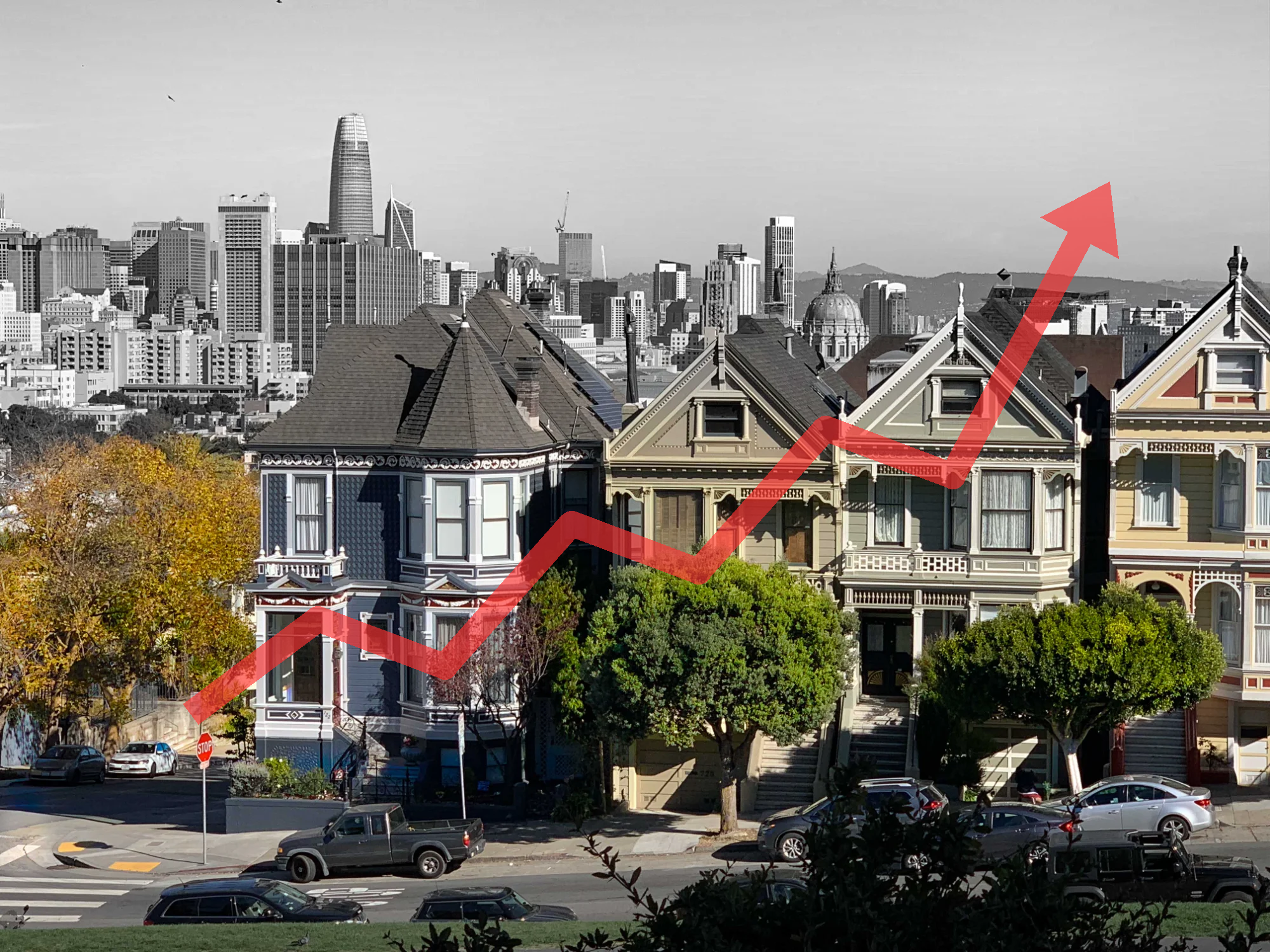
Generated with Claude.ai using a photo taken by Misha Weidman
Image Generated with Claude.ai

In my last post, I wrote that San Francisco’s residential market, fueled by the booming economics of local AI companies, was bucking the trend of most Bay Area counties by showing clear signs of strength while other counties stayed flat or faltered.  Recent data suggests that this trend could be accelerating.

In Contract, Pendings, Sales Volume All Up

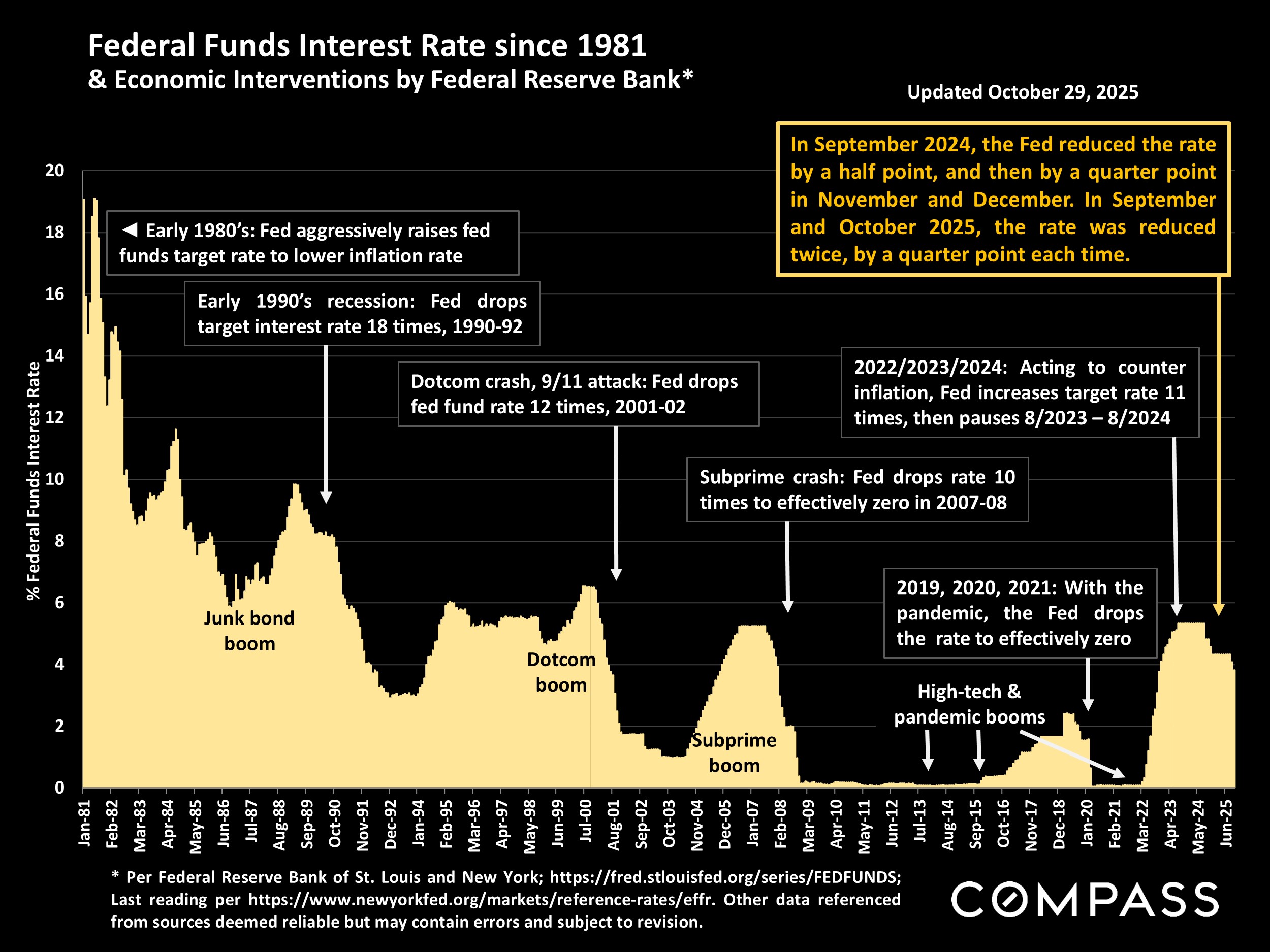
First, let’s recall that the music stopped in Spring, 2022, when the Fed started aggressively raising the Fed funds rate to cool economic activity and accelerating inflation after having kept interest rates near zero during the Covid Pandemic.

Fed funds rate since 1981
Fed Funds Rate

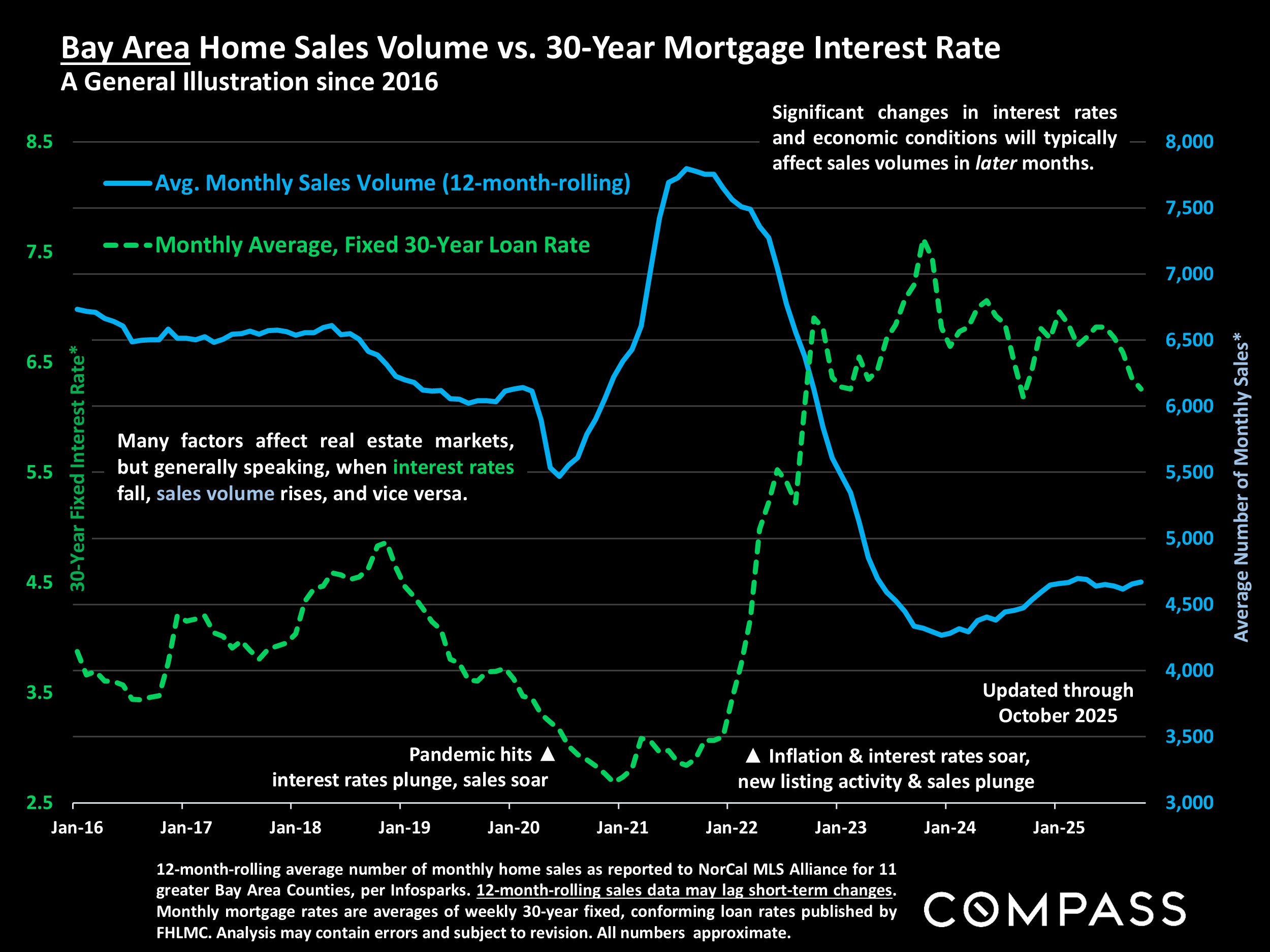
The resulting rise in mortgage rates correlates precisely with a massive slowdown in the Bay Area residential market  as we entered 2022 (chart below).

Mortgage Rates vs Bay Area Home Sales
Bay Area Sales volume vs Mortgage Rates

With that background in mind, many of our statistics are now at or approaching levels they had reached before that 2022 slowdown.  Continue reading “SF Real Estate Heats Up as the Weather Cools Down”

How Does San Francisco Rank as a Global City?

“Home ownership has dropped, evictions and homelessness have climbed sharply, surging demand for rental units has led to a shortage, and soaring rents are fodder for daily conversation…. In the last few years, [it] has become one of the world’s 10 most expensive places to rent, ahead of cities like Tokyo, Sydney and Singapore.”

San Francisco?  Actually, Dublin, Ireland, according to a Deutsche Bank Report cited in a New York Times article a few days ago. But before you heave a sigh of relief, consider this:  Dublin ranked 8th most expensive city in the world to rent a mid-range 2 bedroom apartment, clocking in at around USD $2,000.  San Francisco came in second – just after Hong Kong and ahead of New York.  The quoted rent for SF: a whopping $3,631, down slightly from 2018.

And yet our currently foggy piece of heaven’s Quality of Life Index still ranks among the Top 10 for major global cities covered by the Report, clocking in at number 9.  The only major U.S. City that does better is Boston, at number 8.  (New York ranks 31.). Topping the global index:  Zurich.


Expensive Bad Habits and No Cheap Dates

The Report extracts its Quality of Life rankings from Numbeo.com, which covers cities large and small all over the world and bases its rankings on a combination of individual indices that include Purchasing Power, Pollution, Safety, and the like.

But the Report also includes its own quirky indexes, like the “Bad Habits Index” (cost of 5 beers and 2 packs of cigarettes), “Cheap Date Index,” and “Men’s Standard Haircut in an Expat Area Index.”  No surprise: San Francisco is expensive under all those metrics.  Surprise: San Francisco doesn’t even make the top 54 for (most expensive) Five Star Hotel Rooms with a View.  That honor goes to Milan, Madrid, and Vienna in that order.  Another surprise:  San Francisco ranks third most expensive under Monthly Internet Service, behind Dubai and Dublin.  Thank you, Silicon Valley!

But Lots of Income

One of the major takeaways of the Report: San Francisco tops the charts for both Monthly Income (after taxes) and Monthly Disposable Income After Rents.  It’s jumped 7 and 21 places, respectively, in just the last 5 years.  So, while it’s expensive to rent here, it seems that incomes have more than kept up the pace – though I can’t think of anyone who feels that way.

Boom or Gloom?

With San Francisco real estate prices recently hitting new highs (see chart below), people often ask me where I see the real estate market going.  That’s particularly true now, with so much volatility in the stock market, not to mention underlying geo-political concerns like Brexit, the trade war with China, and oil supplies coming out of the Straits of Hormuz.
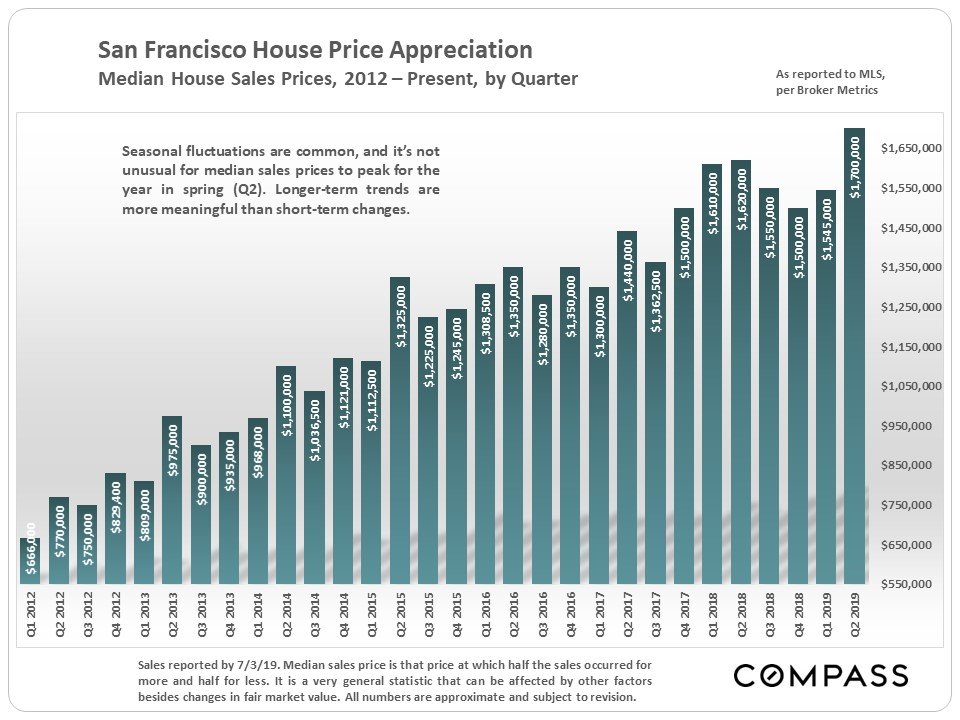
Alas, I have no crystal ball.  But our global ranking is a good part of the reason why I feel bullish about San Francisco in the long-term.  We are a global city, blessed by a thriving and diversified economy; an educated work-force; stunning scenery; and a decent climate (except right now!).  While we aren’t immune from economic downturns, there’s every reason to expect that people will continue to want to live and work here – despite the expense and challenges – for the foreseeable future.

As always, your questions, comments and referrals are much appreciated!

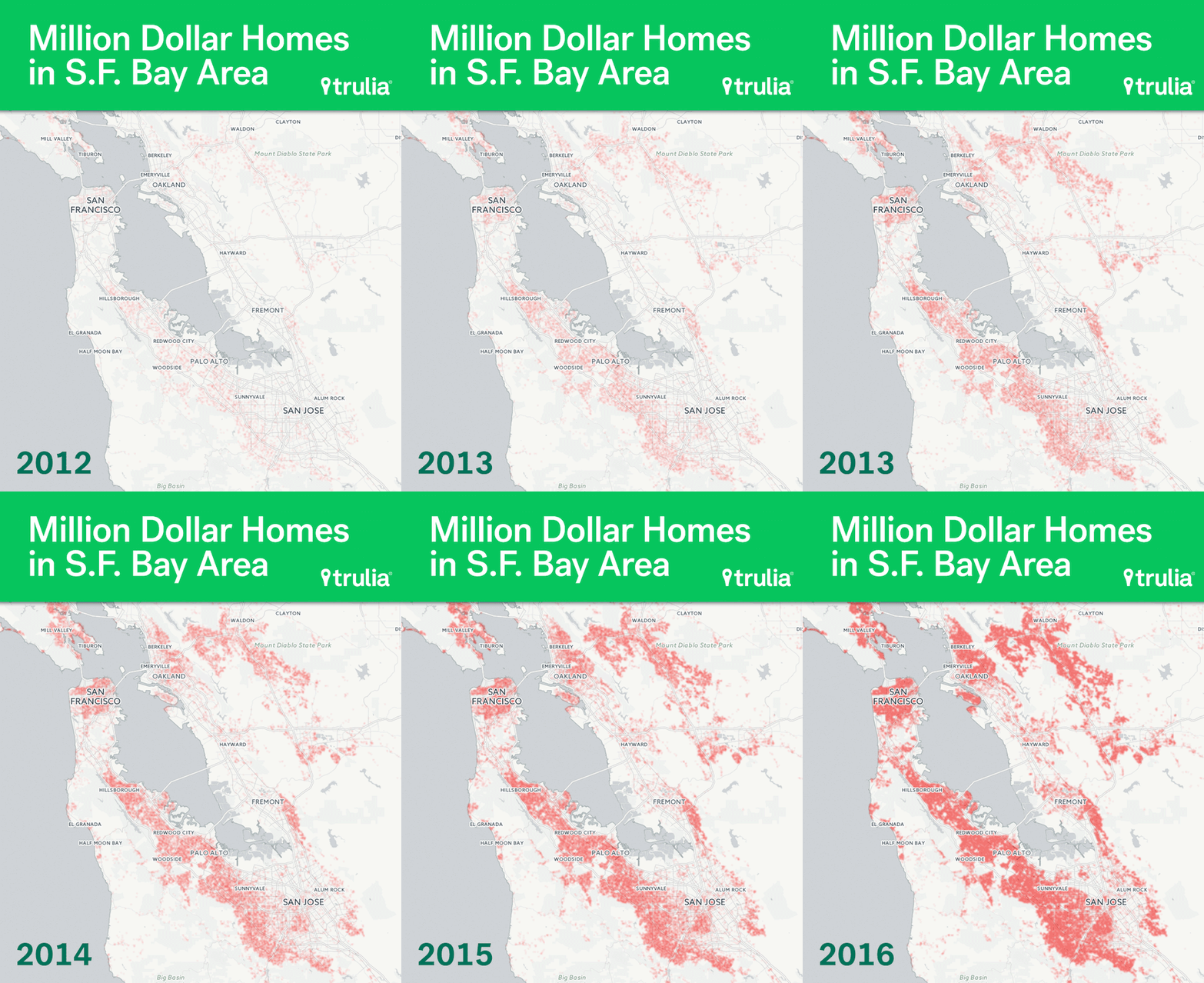
Mapping the Spread of the Million Dollar Home in the Bay Area

Thanks to my well-read friend at The Economist for sending me this fascinating infographic.

You can find the full article here at The Atlantic. Their choice of Westwood Park as their poster-neighborhood is an interesting one. On the one hand, it’s a tiny area tucked in to the west of City College between Monterey and Ocean Avenue and it’s not exactly a household name, even to longtime SF denizens. On the other hand, the statistics are impressive: four years ago, according to the article, just 2.9% of its homes cost $1 million or more. Today, 96% of them do.

Only in San Francisco would a $1 million home be considered “a bargain.” But I think that it’s precisely in the lesser-known neighborhoods loosely clustered around Mount Davidson like Westwood Park, Miraloma Park, and Monterey Heights, where a buyer can still find “value.”

The 2015 San Francisco Real Estate Wrap-Up

1

Happy New Year everyone!  San Francisco residential real estate recorded another year of double-digit appreciation last year.  Our Chief Market Analyst has been busy slicing and dicing the data every which-way, and has created over 20 charts that serve up the market from soup to nuts (which, is exactly how some people view it!).  You can experience the full meal at Paragon Real Estate Group’s main website.  I’m doing the prix fixe menu here for those with less time and/or appetite.

Continue reading “The 2015 San Francisco Real Estate Wrap-Up”

“Bubble” or “Breather”: Whither San Francisco’s Home Market?

image001Just a few days ago, The San Francisco Business Times reported that a third of the national housing experts surveyed by Zillow described the Bay Area’s housing market as being currently in a bubble. Here’s the table that shows how the experts came out on the “bubble” question, courtesy of Pulsenomics, who conducted the survey for Zillow.

Continue reading ““Bubble” or “Breather”: Whither San Francisco’s Home Market?”

It’s Now a Buyers’ Market for Higher End Homes and Condos

“Months’ Supply of Inventory,” or MSI, shows the theoretical number of months needed to “absorb” available homes for sale in a given month based on the number of homes going into contract in a given month. The shorter the time period, the stronger the market for sellers, leading to upward pricing pressure.  Longer time periods indicate slower absorption and a buyers’ market.

The chart below illustrates the dramatic difference in MSI for homes up to the median price ($1.3 million for houses, $1.1 million for condos) and in the next price segment higher, versus the luxury home segment, defined here as houses selling for $2,000,000+ and condos for $1,500,000+. (By this definition, luxury sales currently make up about 20% of San Francisco’s home sales.)
Continue reading “It’s Now a Buyers’ Market for Higher End Homes and Condos”