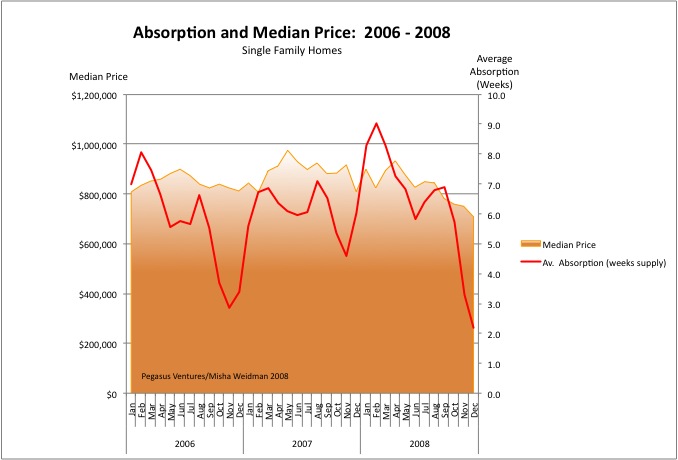
Revised Absorption Chart, but the results are the same, only worse

Thanks, Jean-Claude for making me take a second look at my methodology on my Absorption Chart.  I had anticipated your point about the lag between listing dates and sales but had unfortunately gotten the formula backwards in my chart — basically dividing inventory by lagging sales, rather than forward sales:  moral of the story:  don’t do this stuff at 1 in the morning.)  So I redid the chart with the correct formula inserted.  (Excel groupies its =4*(AVERAGE(listings month 1, 2, 3)/AVERAGE(sales months 2, 3, and 4)). The data points at the end of the chart are averaged over shorter periods due to the lack of forward data.

One can quibble about whether a 30 day lag on listings to sales is sufficient, but the average days on market for 2006, 2007, and 2008 were 29, 41, and 51 respectively.

Here’s the revised chart.  The median price line and the Absorption Rates line up beautifully, don’t they?  Until you remember that there’s supposed to be an inverse correlation between them.  True, there appears to be an inverse correlation over the last few months of 2008, but that could simply be due to the lack of forward data.  It certainly doesn’t negate the lack of correlation over the previous nearly 3-year period.

absorption-chart-revised

Stay tuned for a chart showing median price plotted against Days on Market

Supply/Demand: Does it predict price? Maybe not.

Now hold on there, matie!  Basic economic theory  says more supply than demand, prices will fall, right?  Well take a look at this graph. It shows the absorption rate of single family home listings from January 2006 through December 2008 plotted against median prices (click to make it bigger):

absorption-price-chart1

“Absorption” is basically the number of weeks it would take to sell all the homes available on the market based on the number of homes that are selling at that time.  (I’ve tweaked the formula to diminish the spikes caused by the huge seasonal dropoff in new listings each December/January.)   There are many ways to calculate absorption, but the basic idea is simply to capture how quickly demand is eating supply.  Less time to absorb the supply should reflect a “hotter” market where sellers can demand top dollar. A higher absorption rate, on the other hand, means that there’s relatively more listings on the market than demand for them.  That would tend to suggest a buyer’s market and softer prices.

In the chart above, we’d expect to see  median prices rising when the Absorption Rate line falls and median prices falling as the Absorption Rate line rises.  ie. an inverse correlation.

Well, I’ve looked at this chart long and hard and I just don’t see those lines moving that way at all.  In fact I’ve looked at similar data as far back as 2002 and the only thing that’s clear is that people forget about buying or selling a home at the end of the year. Look at 2006:  the market got tighter but prices stayed pretty flat. In 2007, stuff was being absorbed more slowly (the red line goes up), but prices went up anyway.  In 2008, you’d think that with only two weeks of supply available, home prices would be skyrocketing.  Obviously that aint happenin’.

I’m not an economist or a statistician, but I did get my dear wife, who eats statistics for breakfast, to check my methodology.  I think these results are quite counter-intuitive.  Here are the explanations I can think of.  Please chime in with your own:

  • If you cut off the peaks and troughs, the Absorption Rate  mostly stays within a band of around 4 to 7 weeks.   That suggests that supply/demand in San Francisco is actually pretty stable.  And that in turn suggests that something else must be driving prices.  Note, for example, that my chart  doesn’t reflect the number of offers that are made on any particular house.  There might be 10 offers on a house, but at the end of the day just one house gets sold.  Anyone who was playing during the frenzies of 2005 – 2007 doesn’t need to be told how multiple offers affect price, but that sort of demand isn’t reflected in an absoprtion rate.
  • Relatively speaking, San Francisco is not a stressed market.  Supply/demand is not hugely out of whack.  Foreclosures are not piling up (yet).  Under these circumstances, prices are “sticky.”  They don’t react quickly to changes in demand.  If people don’t get the price they want, what do they do?  They don’t sell unless they really have to.  And SF home-owners tend to be people who don’t have to sell.  More on this in another post.
  • The price increases of the last few years and their recent tumble may are probably most directly attributable to one thing, pure and simple:  easy money.  That aint gonna show up on this graph either.

Conclusion:  “Absorption”  isn’t a good measure of supply/demand.

So is there any other metric that correlates more closely with changes in price?  How about the famous “DOM” — Days on Market.  This is how long a property takes to go from being listed to being sold.  The theory goes that when properties sell quickly the market is “hot.”  Why do properties sell quickly?  Probably because … there’s more demand than supply.  ie.  More people making offers, more people getting the loans they need, more people willing to waive inspection contingencies and buy “as is” just to get the deal done.  So maybe DOM actually does capture those muliple offers where the Absorption Rate just doesn’t.

So will DOM tell us how “hot” the market is and where prices are headed?  Or is DOM dumb.  Stay tuned….

Happy New Year! — The Official Blog Launch

misha-bw

Happy New Year everyone!  I’d intended to illustrate this post with suitable icons for every winter tradition from Christmas to Kwanzaa but decided against it when I  couldn’t think of a suitable graphic for non-believers.  And why should they (we) feel left out?

The image is of a sculpture by Rodin.  I saw it in the Rodin Museum in Paris during the summer of 2008 and, like so many of his sculptures, it seemed to glow from the inside.  For me, these hands express the tenderness and grace that we humans are capable of.  My wish for the New Year is that there be more of both in this  world.

And now, drum roll please….

This is the “official” launch of my blog, which I began writing in earnest last September.

As someone who has reached “a certain age”, I find blogging itself an interesting phenomenon, so I think it’s worth explaining what I hope to do with this blog and why.  Herewith a candid interview with yours truly….

How will your blog be different from other real estate blogs? Good question Misha.  There are lots of real estate agents and brokers who have beautiful websites full of  useful links, gorgeous pictures, and information feeds from other sources.  Very few of them spend a lot of time researching and writing substantive posts on the real estate market (some exceptions are included in my blogroll).  There are other real estate blogs that have a particular take on a specific issue  — for example, East Bay Housing Bubble (on my blogroll) covers… you guessed it.  Still others, like my friends at TheFrontSteps,  blog on everything from the latest real estate news to the best or worst new property listing for the week, and still have time to run a contest on who is San Francisco’s cutest real estate agent.

My blog will be mostly about real estate data and trends, both from a macro and micro point of view.  For example, several recent posts were on a real estate conference about the California real estate market in the context of the global economy. Another post compared  sales price trends of  individual neighborhoods (MLS districts) within San Francisco.  Yet another discussed the often quoted Case-Shiller Index and why it presents a somewhat misleading picture of the San Francisco market.

I’ll also cover subjects that I think are of interest to people who own or are thinking about buying residential property in San Francisco — how much does it cost to put in a garage or adding a new floor, for example.

And  from time to time, I’ll blog about other stuff that interests me — including blogging itself.  It’s a strange phenomenon, this intersection of the personal and the professional, the private and the public.  It almost seems wrong to blog and not be self-conscious about it.

How often will you blog? I hope to post once or twice a week.  My posts tend to be longer because of the nature of the subjects I cover.  And they take more time to research.

Why do you blog? Ah yes, why indeed!  First of all, blogging allows me to combine two of my main interests:  real estate and ‘riting.  Secondly, I believe that people want to know who they’re dealing with.  My posts are my opinions, my research, my writing.  They say something about me, my judgment, my interests.  If you find them useful, then perhaps you’ll think of me when you or someone you know are thinking about buying or selling property.  There’s the sales pitch, and it’s the only one you’ll find on this blog.

So Happy New Year one and all!  Thanks for coming! Come back often. Subscribe to my RSS feed.  Tell me how I can improve this blog and what subjects you’d like to see covered.

And please comment vigorously and often on my posts, or email me.   Because without you, this blog is just me talking to myself.